Employees
Hand off the busywork.
Share Bots across teams and put them to work in the workspace, Slack, or Teams. Review results and approve the actions that need you.
See how Bots workGive your company a place to work with the agents your engineers build. Bring them into everyday workflows, connect the tools people use, and keep access and actions under your company’s control. Your infrastructure. Your code.
Built by CopilotKit, creators of AG-UI.
See the work and act on the result. Review findings, work with interactive results, and approve the next step in the same conversation.
 Read the misconnect playbook
 Read 12 messages in #ops-daily
 Checked 212 connecting passengers
Three turns ran late, all on the evening bank. KT 482 to Boise is the worst at 52 minutes, and 14 of its passengers would miss their connection. I drafted their rebookings on KT 488 for the desk to confirm, and posted the summary to #ops-daily.
14 rebookings drafted on KT 488
 Filed OPS-318 for the Denver station team
 Emailed the Boise station leadPosted to #ops-dailyRead the misconnect playbookRead 12 messages in #ops-dailyChecked 212 connecting passengers
Three turns ran late, all on the evening bank. KT 482 to Boise is the worst at 52 minutes, and 14 of its passengers would miss their connection. I drafted their rebookings on KT 488 for the desk to confirm, and posted the summary to #ops-daily.
14 rebookings drafted on KT 488
Filed OPS-318 for the Denver station teamEmailed the Boise station leadPosted to #ops-dailyOpenBot for Business™ brings employees, IT, and engineers together around the same AI coworkers.
Share Bots across teams and put them to work in the workspace, Slack, or Teams. Review results and approve the actions that need you.
See how Bots workManage who has access, which tools Bots can use, and which actions need approval. Choose where the workspace runs and keep an audit trail.
Explore deploymentConnect your existing agents, models, and tools. Give your company one workspace to use them without rebuilding your agent stack.
Connect your agentsOpenBot is a composable workspace for your agents, models, and tools. Its modular design lets you switch model providers or connect a new tool while keeping the agents and infrastructure you already use.
Connect Claude Agent SDK, LangGraph, Google ADK, or another AG-UI-compatible agent. Your prompts and tools come with it.
Connect your agentUse OpenAI, Claude, or Gemini with your own API keys. Keep the provider relationships you already have.
 OpenAI
 Claude
 Gemini
Connect your existing MCP tools or choose integrations from the available catalogs. Give each Bot the access it needs, with company policies governing what it can do.
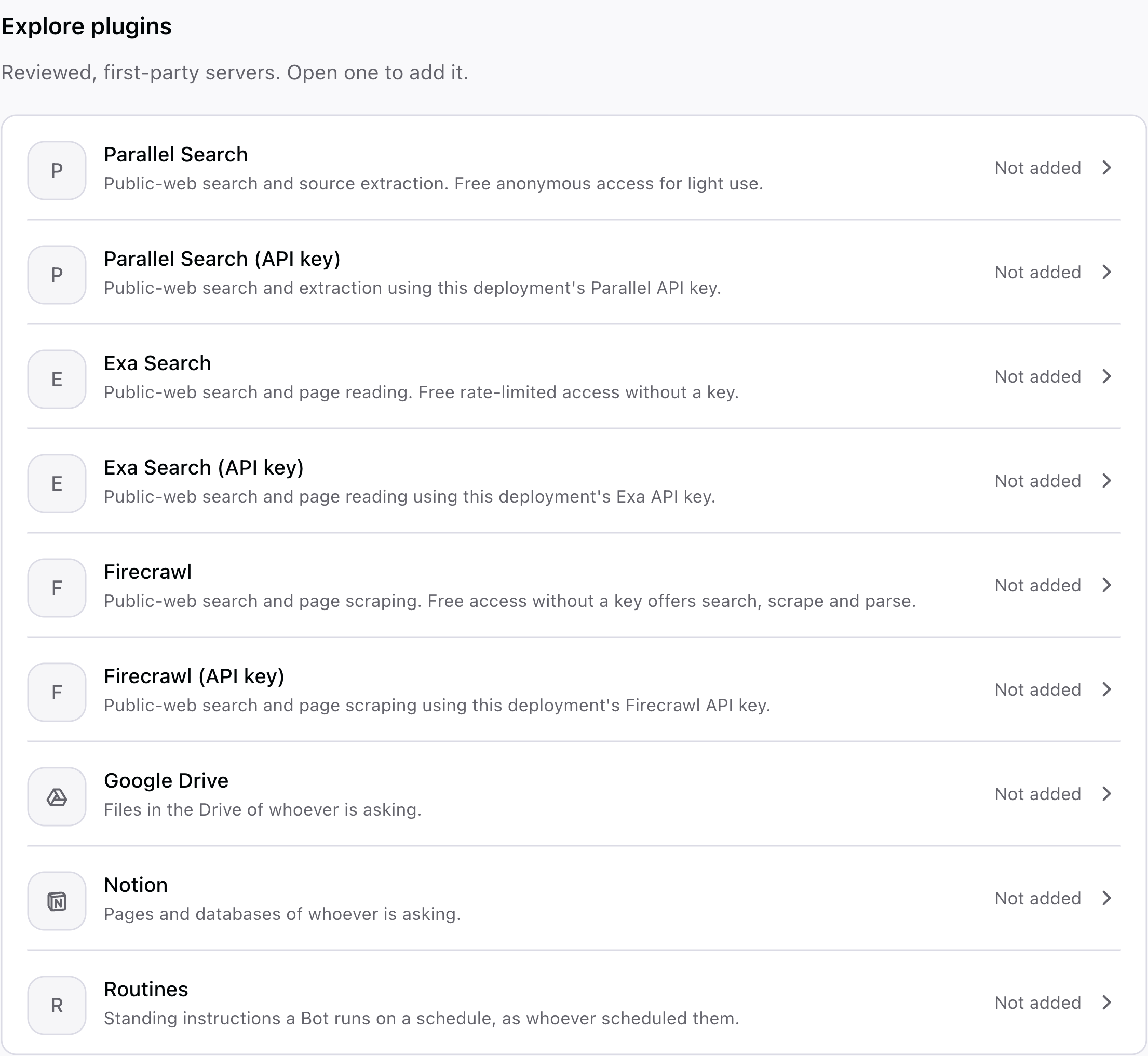
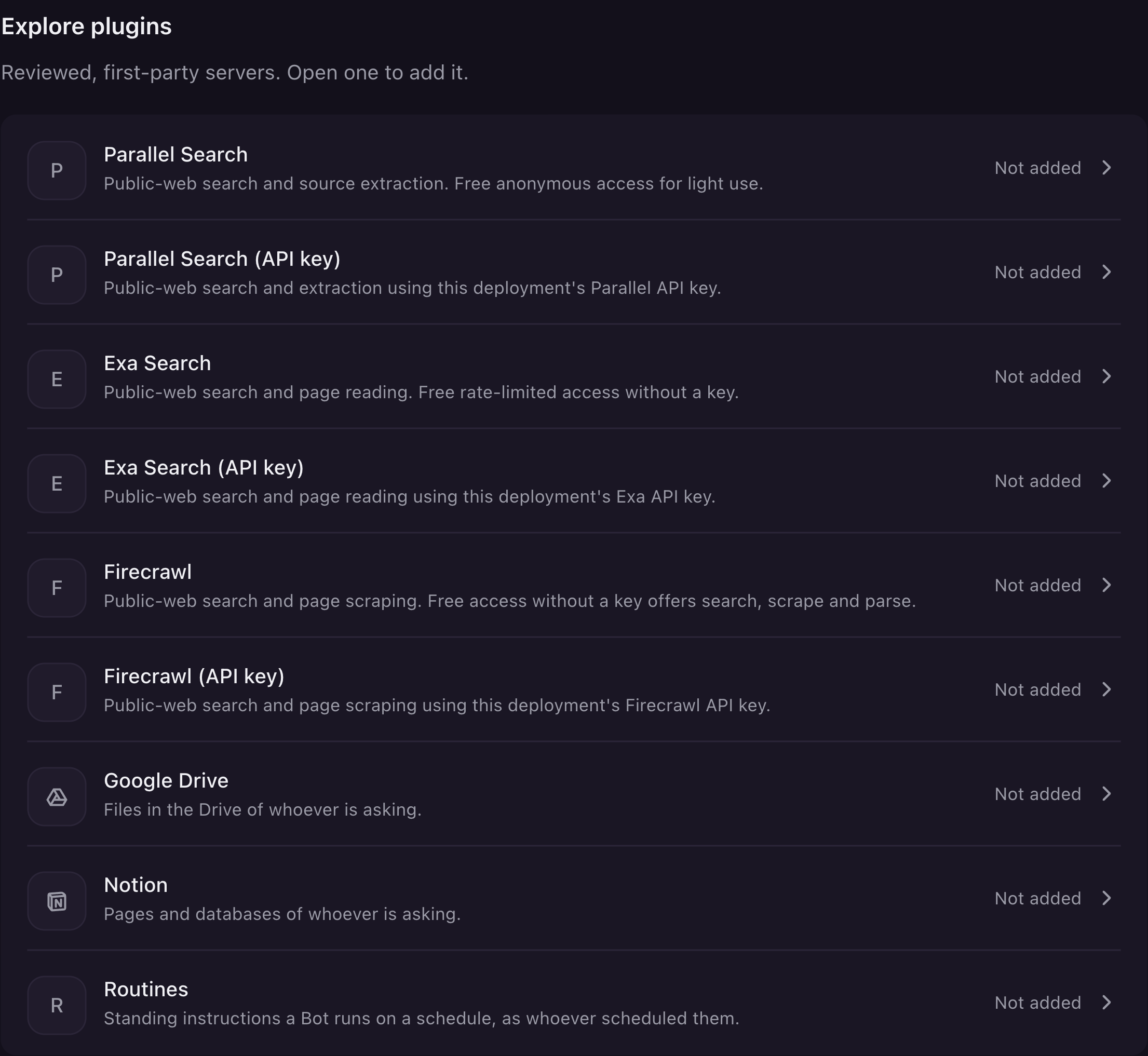
Enable the services your team needs, then grant tools to the Bots that need them. People connect their own accounts.
Block actions that should never happen. Require approval for sensitive work, so people keep the decisions that matter.
Review the audit trail when a task needs attention. Your admins can trace actions and decisions instead of chasing context across chat windows.
Teach your agents directly, or let them learn from everyday work. OpenBot observes patterns, develops reusable skills, and improves how tasks get done, with people in control.
Decide what agents can do, what needs approval, and what stays off limits. Give your security team a record of the actions taken.
Read ticket#4821 Postedin #support
Posted in #support and assigned #4821 to Billing.
Access check
Posting to #supportAsk a person firstAllowed by Dana Ruiz
Recorded 10:42:07
Show an agent how a task is done to teach it directly. It also learns as it works, picking up patterns and turning successful approaches into skills. You don’t have to teach every step for your agents to get better.
From a developer’s laptop to a company’s private infrastructure. Run it yourself or talk to us about a hosted cloud deployment.
Connect your agents and tools, and try a workflow on your laptop.
Work with our engineers on a focused proof of concept, with agreed goals and success criteria.
Choose your deployment, connect company identity, and bring more teams on board.
Give your team AI coworkers without moving the workspace outside your infrastructure. Your admins control access, data, and the services it connects to.
Start on your laptop, connect your team’s messaging tools, or request early access to web and mobile.
Your Bots, tools, and conversations in one workspace on your Mac or Windows laptop.
One person sets the direction. An orchestrator coordinates specialists across six functions, with a person approving the work that matters.
This is a real story of a company that built its entire go-to-market team on OpenBot, with 20 AI agents in real roles and one executive setting the direction.
An executive needed to build a go-to-market team to handle all of the company’s sales and marketing work, except meeting directly with buyers. That part had to be done by people.
Using CopilotKit OpenBot, the company made 20 AI agents, and one person built them all and runs them.
Each agent holds a real GTM role, such as growth strategist, ABM specialist, demand gen manager, enterprise SDR, RevOps engineer or pipeline strategist. Each one has a written job description and works in its own tools. Across the team, those come from seven products:
The agents picked their own names, each after a TV or film character who fits the job. That is how the demand gen manager became Don Draper, the program manager became Leslie Knope and the librarian became Rupert Giles.
One agent sits above the specialists. Nicky Fury, the orchestrator, takes direction from the executive, assigns each piece of work to the right specialist and coordinates the hand-offs between them.
Work starts with a message from the executive. It can be a single line, such as “Build pipeline for the AWS launch by Friday.” Nicky Fury works out who should do what and passes each part to a specialist, who does it in their own tools and hands the result on to whoever needs it next.
When the outreach is ready, the executive approves it before it goes out.
Every night, a QA analyst audits the team’s output. A program manager runs the work in two-week GTM cycles, and a librarian keeps the team’s shared memory, so lessons from one cycle carry into the next.
The executive sets the strategy and makes the decisions only a person can make, and people still hold every meeting with buyers. The agents do the rest of the work, across strategy, marketing, sales, data and RevOps.
Bring the agents you want. Run them on your infrastructure. Give your whole company one place to work, with IT in control.
| Feature | OpenBot for Business | GrokBot | Muse | Hermes |
|---|---|---|---|---|
| Bring your own agents | Any AG-UI agent | GrokBot only | Muse only | Hermes only |
| Choose your models | Included | Not available | Not available | Included |
| Fully self-hosted workspace | Included | Not available | Not available | Included |
| Company identity | SSO + SCIM | SSO + SCIM on Enterprise | Personal accounts | SSO on Enterprise |
| Action policies | Central controls | Enterprise controls | Personal approvals | Per install |
| Deployment support | Our engineers or hosted service | Hosted service | Hosted service | Enterprise option |
| Learn more | Book a demo | Read comparison : OpenBot vs Grok Bot | Read comparison : OpenBot vs Meta Muse | Read comparison : OpenBot vs Hermes Agent |
 Anthropic
 OpenAI
 Gemini